

People with a very active thinking mind often have a need for information, answers, understanding and solving problems. Often asking “what if” questions, for people that worry about the toilet and needing a toilet when they are out, this can spiral.
“What if I don’t make it?”
“What if I need the toilet?”
“What if I can’t find a toilet in time?”
Over time, this thought cycle can start to influence everyday decisions — where to travel, how to travel, how long to stay somewhere, or whether to attend certain events.
Once that thought appears, it can quickly lead to anxiety, heightened body awareness, and a growing sense that something might go wrong.
The good news is that this cycle follows a recognisable pattern, and patterns like this can be changed.
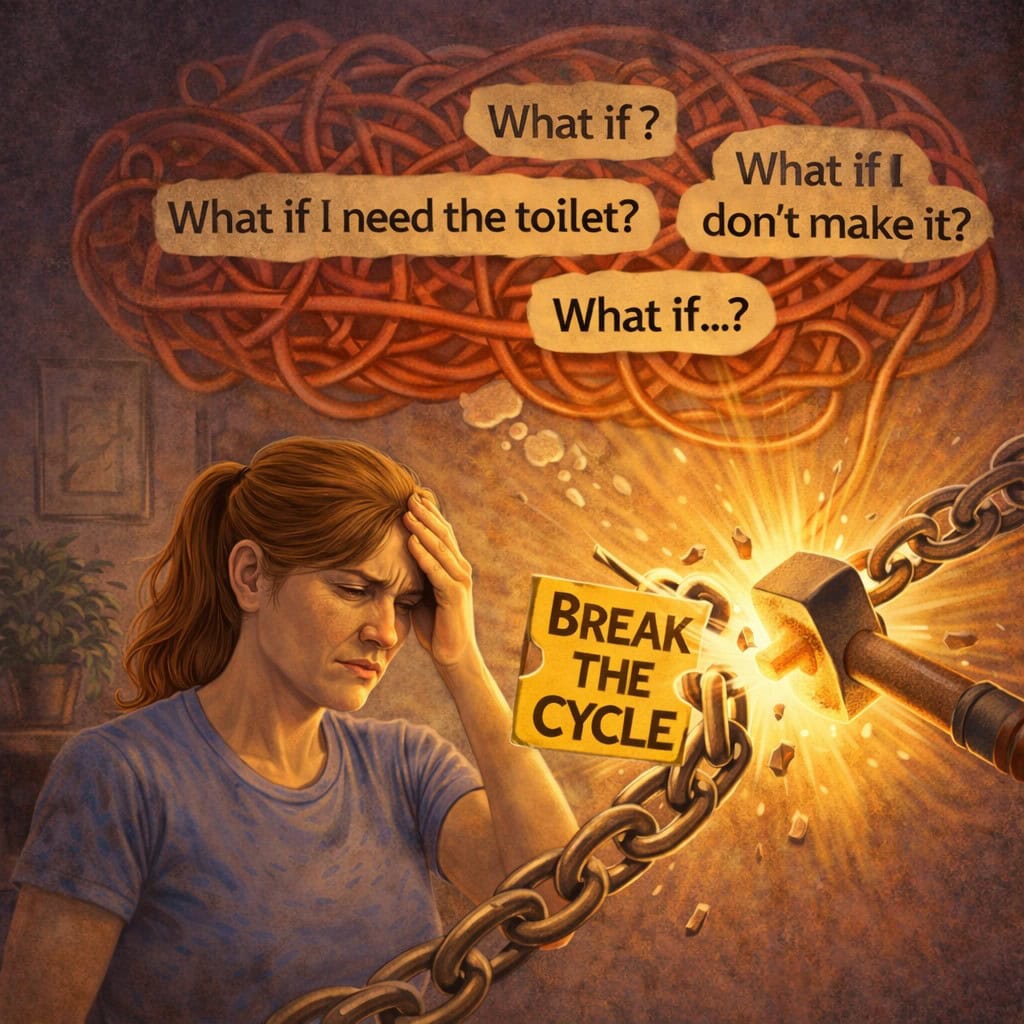
Understanding the “What if” Thought Cycle
The pattern often begins with a situation where leaving quickly might be difficult.
For example:
- a train journey
- a long meeting
- heavy traffic
- unfamiliar places
The mind then generates a predictive thought:
“What if I suddenly need the toilet?”
That thought can trigger anxiety, which activates the body’s alert system.
As anxiety increases, internal sensations become more noticeable. This can make the urge to go feel stronger, even if the sensation was mild to begin with. The mind then interprets the sensation as confirmation that the feared worst case scenario might actually happen.
And the thought returns:
“What if I don’t make it?”
This creates a loop between thought, sensation, and anxiety.
Why Trying to “Stop the Thought” Often Doesn’t Work
Many people try to solve this by attempting to push the “What if” thought away or reassure themselves that nothing will happen. While this can sometimes help temporarily, it rarely changes the overall pattern.
That’s because the stress reaction is not only happening in conscious thinking. It is also being driven by the nervous system, which is responding automatically to the imagined scenario.
Trying to force the thought away can sometimes make the mind focus on it even more.
A Different Approach to the Thought
Instead of trying to eliminate the thought entirely, it can be more helpful to recognise it for what it is:
A prediction.
The brain is attempting to anticipate a possible problem. But a prediction is not the same as an event. Learning to notice the thought without immediately reacting to it can gradually weaken the cycle. For example, when the thought appears, it can be helpful to mentally label it:
“I’m predicting”, “That’s the prediction again.”
This creates a small amount of distance between the thought and the body’s reaction.
Reducing the Cycle of Monitoring
Another part of the pattern often involves monitoring the body for signs that the feared situation might happen.
For example, repeatedly checking whether you feel any sensation from the bladder or bowel.
The difficulty is that the more attention we give to a sensation, the stronger it can appear. Learning to shift attention away from constant monitoring can reduce the intensity of those sensations.
Rebuilding Confidence Gradually
As the brain learns that these situations do not lead to the feared outcome, the anxiety response often becomes less intense. Confidence builds through evidence, and building that evidence gets easier and easier as your mind catches up with the learnings and you start to create new patterns.
As you build the evidence, the predictions of the worst case scenarios becomes less convincing.
When the “What if I need the Toilet?” Cycle Has Been Running for a While
If the “what if I need the toilet” thought has been present a long time, it can become deeply ingrained. In those cases, it can be helpful to work with someone who understands how the cycle develops and how it can be retrained. Get in touch via the book now or contact page.