

Are you afraid of having an accident when out? Maybe you are afraid of losing control of your bladder or bowels and not making it in time, of wetting yourself or pooing. It’s not really about the toilet. It’s about control, dignity, and safety — very human things.
There are a number of reasons we are so afraid of having an accident and it can manifest in many ways.
From childhood, we’re taught that control equals safety
One of the first major developmental milestones is toilet training. It is when a child learns:
- There is a right time and place
- There are expectations about control
- Losing control can feel embarrassing
- Being in control is praised
So very early on, the brain links:
Control of bodily functions = competence, maturity, safety
That association sticks for life. Not consciously, but emotionally.
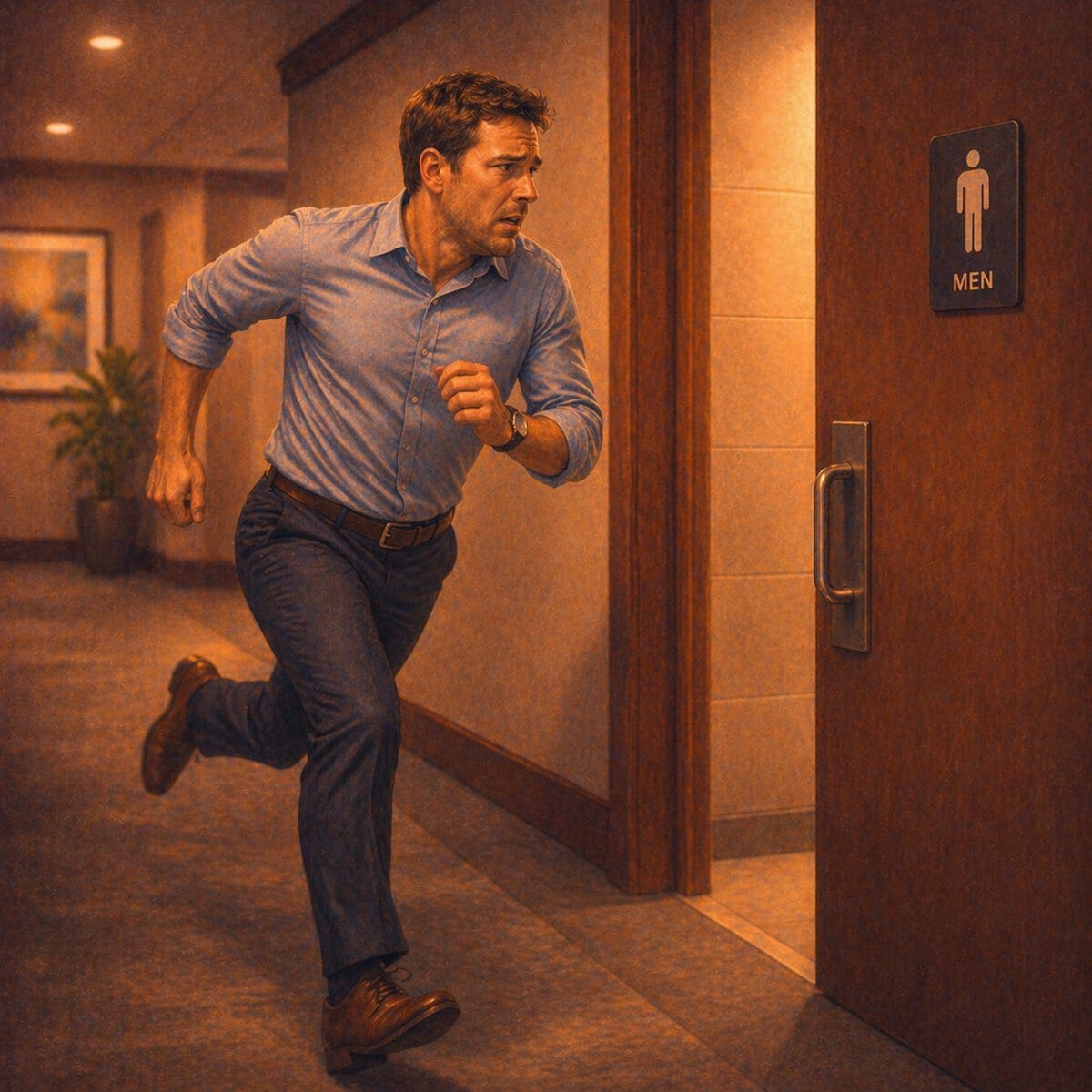
Having an accident and losing control of bodily functions is socially risky
Historically to survive, humans needed to be social animals and belong to a group.
Therefore, anything that could lead to embarrassment, rejection, loss of status or being judged could jeopardise our position in the group, it could feel like a threat to our survival,
Accidents, especially in adulthood carry a strong social meaning. Accidents can mean a loss of dignity, a loss of competence, a loss of control, being judged and a loss of belonging.
So the brain treats the possibility as, “This must not happen.” Even if the actual risk of having an accident is tiny.
The brain is wired to prevent worst-case scenarios
Your brain is designed to protect you, it is not designed to be calm. So when it detects even a small possibility of: “What if I can’t get to a toilet?”
It responds by:
- scanning the body
- increasing awareness of sensations
- preparing for action
- trying to stay in control
This is not weakness, it’s the brain doing its job, it is just doing it a bit too enthusiastically.
Control reduces uncertainty and humans dislike uncertainty
At a deeper level, this is about predictability. The brain likes to predict and with that comes control.
We feel safer when we know:
- when we can go
- where the toilet is
- that we will make it
When those things feel uncertain, for example: being stuck in traffic, sitting in a meeting, travelling, being somewhere unfamiliar, being unable to easily leave or get out, the brain tries to regain control.
Often by, checking, planning, going “just in case” and protection mechanisms.
The body is one of the last things we can’t fully control
We can control many things, what we say, what we do, how we behave (to an extent) but bodily functions are partly automatic. Our subconscious mind manages breathing, heart rate, digestion
bladder signals etc
That lack of full control makes the brain uneasy, especially for people who when responsibility, reliability, and composure are important.
Why this becomes anxiety for some people
Most people want to feel a level of control
But anxiety develops when the brain starts treating the possibility of losing control as possible and as danger.
So the focus shifts from, normal concern to constant monitoring. And then, monitoring to heightened sensation and then heightened sensation to fear of losing control and that’s the loop.
How to overcome the fear and stop being afraid of having an accident
Humans don’t want (need) perfect control, what we actually want is confidence that we can cope.
The goal needs to be, “I can handle whatever happens”, not “I must never lose control”
That shift is what reduces anxiety.
Therefore, my goals for therapy are looking at the beliefs underneath“I must stay in control”, “I can’t risk embarrassment”, “I have to be certain” so that we can restore trust in the body and reduce the need for absolute control.
If this sounds familiar, it can be helpful to work with someone who understands how the cycle develops and how it can be retrained. Get in touch via the book now or contact page.