

Why It Happens (and What Actually Helps)
You’re out, maybe shopping, travelling, in a queue, theatre or meeting someone and suddenly you become aware of sensations or movement in your body. It often follows with a thought, “What if I need the toilet?”, and almost instantly, “What if I don’t make it?”. The fear of needing the toilet is very real.
From that point on, it can feel hard to switch off.
You might find yourself:
- checking where the nearest toilets are
- staying close to exits
- avoiding certain places altogether
- going to the toilet before leaving — sometimes more than once
- constantly scanning your body
Even if you know you’re probably fine, you don’t actually need the toilet, the feeling still builds.
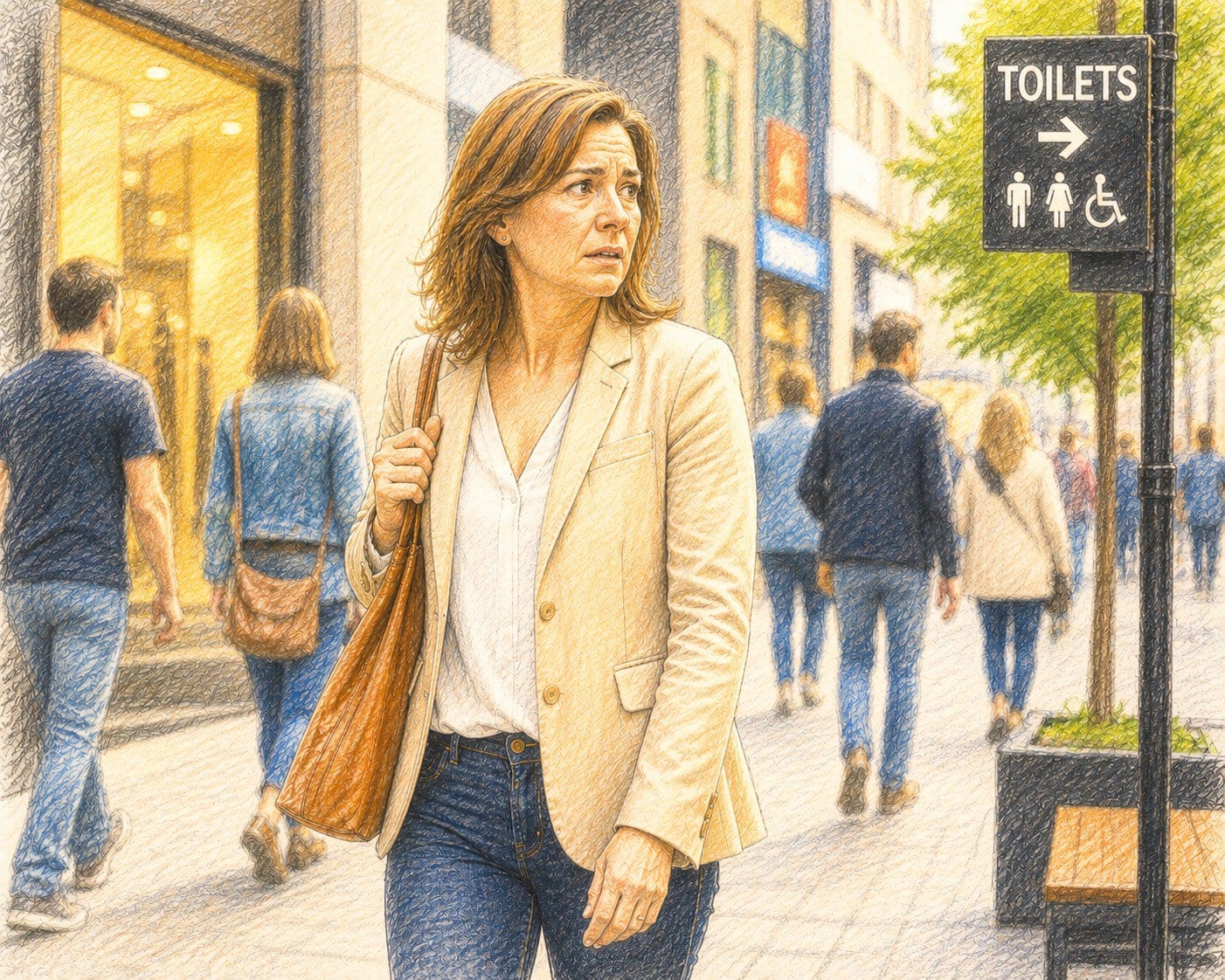
What’s really driving the fear
It might feel like the problem is your body and needing the toilet. But for most people, the fear isn’t really about the toilet itself. It’s about the possibility of:
- being stuck
- not being able to leave
- losing control
- feeling embarrassed or exposed
In other words, this is less about your body, and more about what might happen if you couldn’t act on it.
Why it gets worse when you’re out
This pattern often feels stronger outside the house, because when you’re out:
- you have less control over your environment
- you’re less certain about where toilets are
- you can’t always leave immediately
- there’s more social pressure to stay composed
So the brain starts asking, “What if I can’t deal with this here?” And that increases your awareness of your body. Suddenly, the sensation can feel very real, and very physical.
Why the sensations suddenly feel more urgent
Anxiety changes how your brain processes signals from your body.
- The more you focus on a sensation, the stronger it feels
- Tension in your body can create pressure-like sensations
- Your brain becomes more sensitive to normal signals
A simple way to understand it is, the more your brain watches your body, the louder your body feels.
The “what if I don’t make it to the toilet” loop
For many people, the experience follows a very predictable pattern:
- You notice a small sensation
- You think: “Do I need the toilet?”
- That turns into: “What if I don’t make it?”
- Anxiety increases
- The sensation feels stronger
- The urgency feels more real
And once that loop starts, it can build quickly.
What people naturally do (and why it backfires)
Most responses make sense in the moment:
- going to the toilet repeatedly “just in case”
- avoiding places where you feel trapped
- planning routes around toilet access
- constantly checking how your body feels
These can reduce anxiety short term. But they also teach your brain, “This situation is something to worry about.” And so the cycle continues.
What actually helps
The goal isn’t to force the feeling away. It’s to stop the escalation.
A simple approach you can use in the moment:
1. Label what’s happening
Instead of: “I need the toilet”
Try: “This is the anxiety pattern starting”
2. Drop the “what if” thought
When the thought appears: “What if I don’t make it?”
Gently respond with: “I don’t need to solve that right now”, “What else needs my attention”, “what do I need to do right now”
3. Let the sensation be there
Instead of checking or reacting: Allow it to sit in the background. You’re not ignoring it, you’re just not feeding it.
A more helpful way to look at it
Instead of: “Something’s wrong, I need to act now”
A more accurate interpretation is: “My brain is trying to protect me, and that’s making this feel urgent” .
That shift alone can reduce the intensity.
Why you often feel better when you get home
Many people notice the feeling fades when they return home. That’s not because your body suddenly changes.
It’s because:
- you feel safe
- you know where the toilet is
- you can act immediately if needed
In other words: The uncertainty disappears and the anxiety settles.
The real shift that helps long-term
The instinct is to try and stay in control at all times. But what actually reduces anxiety is something different: confidence that you can cope
That means moving from:
“I must not lose control”
to:
“Even if I feel uncomfortable, I can handle this”
Final thought on the Fear of Needing the Toilet when out
This fear is very common, especially in situations where you feel exposed or unable to leave easily. It’s not a sign something is wrong with your body.
It’s a pattern your brain has learned in response to uncertainty and control.
And anything learned…can be unlearned. If this sounds familiar, it can be helpful to work with someone who understands how the cycle develops and how it can be retrained. Get in touch via the book now or contact page.